The Roman Institute has, at the end of 2025, with 277 members continuously increased its membership share of the entire Görres Society within 14 years from 2.47 % to now 9.37 %, although the membership of the entire Görres Society is growing again (2021: 2.806; 2022: 2.840; 2023: 2.871; 2024: 2.908; 2025: 2.955). The strongest section of the Görres Society in terms of numbers is History. Most of the new members of the Roman Institute also join this section.
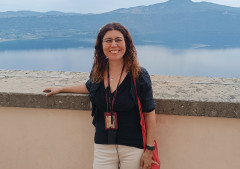
Ciro Amato (Naples, 1974) has a degree in clinical psychology and studies topics related to the history of natural medicine, with a particular focus on Saint Hildegard of Bingen. He obtained a PhD from the University of Naples Federico II, thanks to which he acquired scientific research methods, including in law; he also has a degree in law.
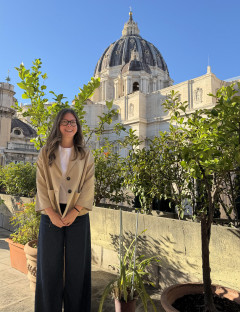
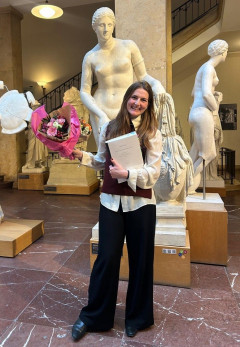
Lea Amodio (Naples, 2004) attended classical high school and is currently studying philosophy at the Lateran University (with a thesis entitled ‘Time, Love and Knowledge in Joseph Ratzinger’). She is also completing a master's degree in the preservation, protection and enhancement of analogue and digital archives at Roma Tre University.
Lorenzo Murrone was born in 1998 and graduated from Roma Tre University with a degree in philology, literature and ancient history, writing his thesis on the development of the cult of saints in Eastern Christian liturgies. He is currently a visiting professor of Ancient Greek at the Pontifical Salesian University in Rome. He also serves as a pastor in the Lutheran Confessional Church of Italy, ministering to the congregation in Rome and visiting other congregations on the peninsula.
Just in time for the 150th anniversary of the Görres Society, a 92-page, richly illustrated, practically square brochure has been published to present the society, its members, specialist sections, publications, institutes and conceptual course for the coming years. The Roman Institute is presented on pages 62-64.
The Roman Institute of the Görres Society continues to grow. Last year, the number of members rose from 267 to 277, 212 of them men and 65 women. Although 25 new members were recruited, the growth rate remained lower due to departures, resignations and deaths.
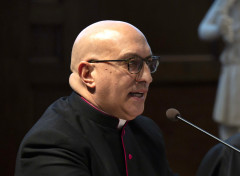
My name is Fr. Ezio Giovanni Maria Russo OP (born Ezio Antonino). I was born on 3 February 1976 in Gela. I attended the Vincenzo Linares Classical High School in Licata, after which I enrolled in the Degree Course in Conservation of Archaeological Cultural Heritage in Agrigento, a branch of the University of Palermo, then located in Villa Genuardi, a jewel of Girgenti (Agrigento), with a magnificent monumental garden overlooking the Valley of the Temples, now owned by the FAI and home to the Superintendence for Cultural Heritage.
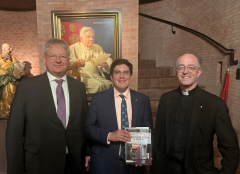
Simone Raponi, priest of the Congregation of the Oratory of St. Philip Neri (Rome) and PhD in Cultural Heritage of the Church (Pontifical Gregorian University), is Prefect of the Archives of the Congregation of the Oratory. He holds the positions of Curator of Cultural Heritage for the Archdiocese of Luxembourg and Ecclesiastical Counsellor for the Embassy of Luxembourg to the Holy See. His research and publications focus in particular on the history of papal ceremonies and the Congregation of the Oratory.
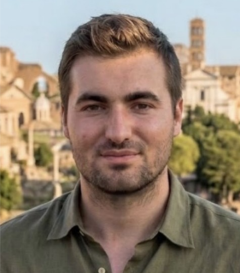
Maximilian Welticke (born in Korbach in 1999) studied Catholic theology and philosophy in Paderborn and Oxford. Since October 2025, he has been studying moral theology for his licentiate at the Pontifical University of St. Thomas Aquinas (Angelicum) in Rome. In November 2022, he joined the Young Forum of the Görres Society; since September 2025, he has been a member of the Roman Institute of the same society. He is a scholarship holder of the Konrad Adenauer Foundation and conducts research in the field of political ethics.
Dr Konstantin M. Brandenburg (born 1964) studied architecture at the University of Rome, where he obtained his doctorate. This was followed by various research projects on the early Christian and late antique churches of Rome: S. Stefano Rotondo, S. Paolo fuori le Mura, S. Pietro in Vaticano, S. Agnese flm, S. Costanza, S. Maria Maggiore and S. Lorenzo flm.