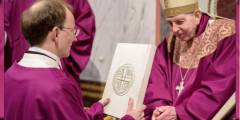
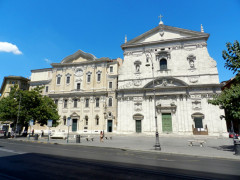
On 17 December, our member Frater Anselm Demattio OSB from the Upper Austrian Benedictine Abbey of Kremsmünster - where the famous Tassilo - Liutpirc Chalice is kept - was ordained deacon in Sant'Anselmo on the Aventine.
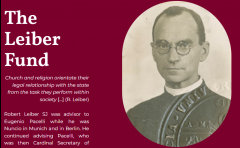
The Historical Archive of the Gregorian University in Rome offers immense treasures on the history of Roman science, in which the Jesuits played a role one way or another. There is a blog in which interesting aspects and archival documents are pointed out again and again. Currently, the Father Leiber collection is being processed. As the right-hand man of Pius XII, the German Jesui Robert Leiber was a key figure in the day-to-day operations of the papal court. His legacy, however, is by no means immediately readable for everyone, as Leiber used to use a rapid script that needs to be deciphered.
Cardinal Ravasi, until now President of the "Catacomb Commission", is replaced by the previous Secretary, Mons. Pasquale Jacobone. He in turn will be replaced as secretary by Dr Raffalla Giuliani. In practice, this will not result in any major change.
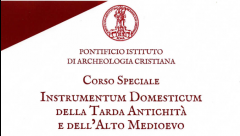
For the 24th time, the Pontifical Institute for Christian Archaeology is offering a weekly course on the production and distribution of materials and small objects in Late Antiquity from 6 to 10 March 2023.
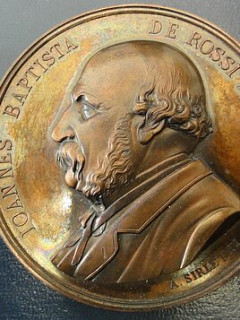
On 12 December at 5.30 pm, the volume of the conference on the Christian archaeologist Giovanni Battista de Rossi (1822-1894) will be presented at the Pontifical Institute for Christian Archaeology. The conference took place in February and paid tribute to previously unknown aspects of de Rossi's archaeological work and biography. At the book launch, Domenico Palombi (Rome) will acknowledge the archaeological and Agostino Giovagnoli (Milan) the historical output of the volume. The Pontifical Institute and the Pontifical Commission for Sacred Archaeology invite you to attend.
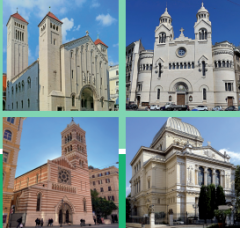
From 17-19 November, an English-Italian-language conference on "Pluralisation of Religion in Rome between the End of the Papal State and the Beginning of Fascism (1870-1922)" will be held at the German Historical Institute in Rome, organised by Martin Wallraff (Munich). The topic is the non-Catholic religious presence in Rome.
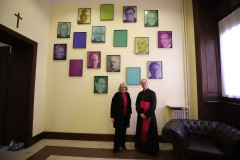
Austrian multimedia artist and photographer Cornelia Mittendorfer has presented her installation of photo portraits of the 11 rectors of the Pontifical Institute of Christian Archaeology in the anticamera of the rector's office. The founding rector of the Institute is the Luxembourg priest Johann Peter Kirsch, who hangs in the geometric centre of the wall and is depicted solely in black and white.
Ingo Herklotz will speak on "Alonso Chacón e i primi studi sulla Roma sotterranea" in the Salone Borromini of the Biblioteca Vallicelliana (Piazza della Chiesa Nuova) on Wednesday, 9 November at 5 pm.
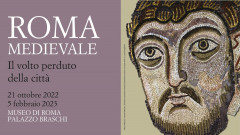
In the Museo di Roma (Palazzo Braschi) near the Piazza Navona, a special exhibition on "Roma medievale: Il volto perduto della città" is on show until 5 February. The exhibition is worthwhile for long stretches, but it weakens somewhat the further you go. It begins with the great basilicas of Rome and then deals with topography, everyday life, liturgy, etc. and ends with the medieval vedute of the 19th century. Unfortunately, in many cases only facsimiles are exhibited, but one is used to that by now because of the insurance sums. Original frescoes rescued from churches in the 19th century are important elements of the exhibition.
 Römisches Institut der Görres-Gesellschaft